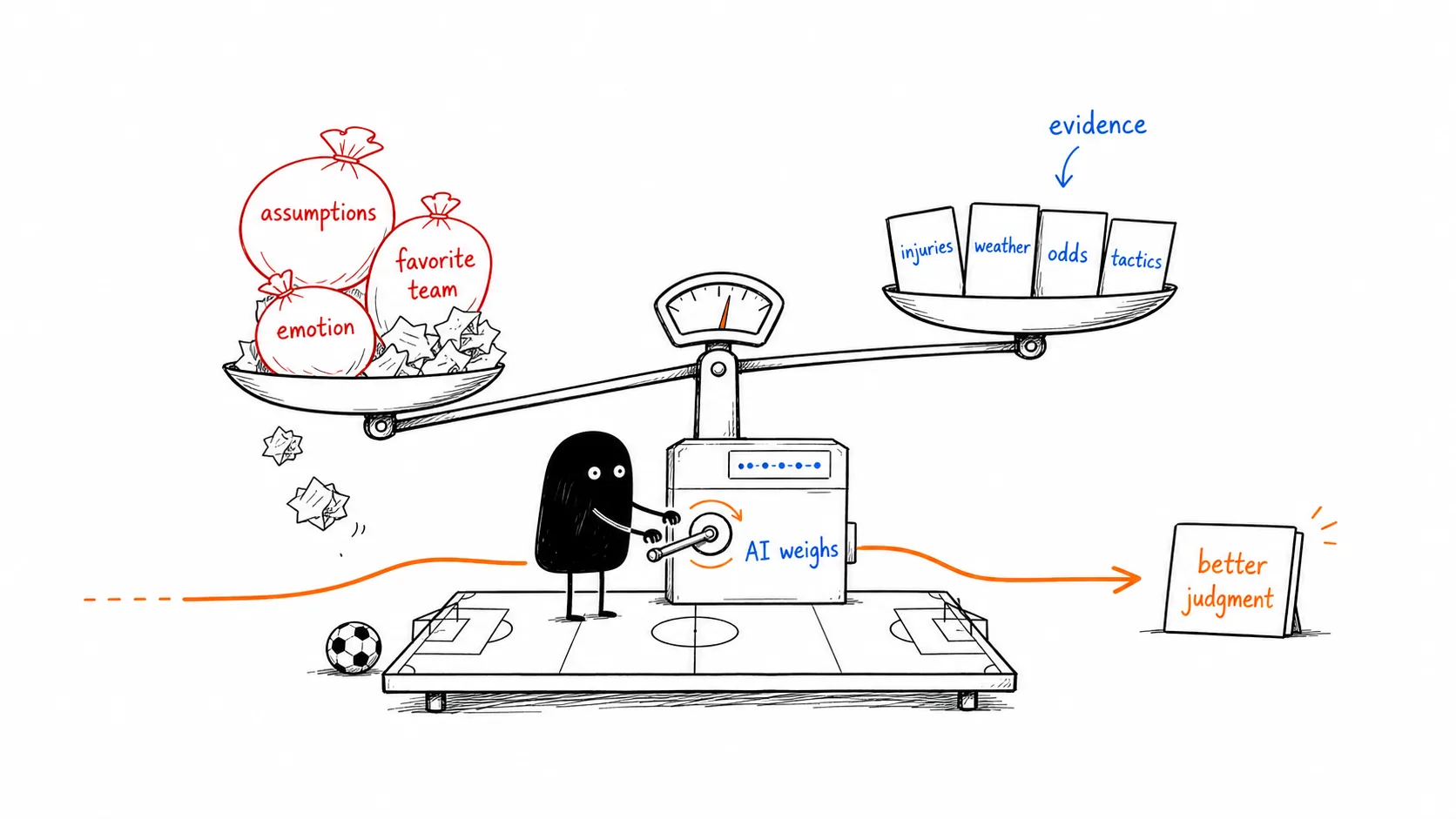
Over the past 50+ World Cup matches, I experimented with using AI and Codex as a decision-making assistant while watching the games.
The goal was not to let AI predict everything or make decisions for me. It was to use AI as a disciplined co-pilot: gathering information, summarizing signals, tracking mistakes, and helping me stay rational when emotions were high.
Through this experiment, I started to believe these ideas go beyond sports betting. They may apply to business, investing, product decisions, and many other high-uncertainty environments.
-
1. AI is emotionless, and that is why it is useful.
Humans often make emotional decisions, especially in sports betting. We overreact to momentum, favorite teams, narratives, and fear of missing out. AI helped me stay more disciplined: when to buy, when to sell, when to wait, and when the market created a lower-risk opportunity.
-
2. AI can compress the work of a research team.
Before each game, I used AI and Codex to summarize odds movement, team news, injuries, weather, tactical analysis, and expert opinions. Instead of reading 10 sources manually, I could get a structured briefing in minutes.
-
3. AI becomes more valuable when it learns from mistakes.
After each win or loss, I logged what happened, what I assumed, what I missed, and what I should watch next time. Over time, AI became a memory system that reminded me of repeated mistakes before I made the same emotional decision again.
-
4. Do not blindly trust AI. Human judgment still matters.
If I had let AI make every decision, I would have missed profit. AI could read numbers and news, but it could not fully sense the rhythm of the game, player confidence, crowd pressure, or momentum shifts. The best results came from combining AI's rational analysis with human intuition.
-
5. AI can scale decision-making capability.
Once a workflow works, it can become a repeatable tool, app, or skill. That is the real opportunity: not just using AI once, but building systems that help more people make better decisions with less effort.
The bigger point
Many poor decisions are not caused by lack of intelligence. They are caused by unchecked human assumptions: the stories we tell ourselves, the signals we overvalue, and the facts we ignore because they do not fit our preference.
AI gives us a new way to make decisions, not because it has the final answer, but because it can help us weigh relevant information with less personal bias, challenge assumptions, and pressure-test decisions before we act.
Boundary
This is a personal decision-making experiment, not betting advice. The useful part is the workflow: use AI to organize evidence, reduce bias, and make the human decision process more structured.