One challenge I often run into: when sharing technical methods or case studies with non-technical teams, dense slides and long definitions can make people tune out before the real conversation starts.
The issue is not that stakeholders cannot understand the method. The issue is that the method has not been turned into a shared mental model yet.
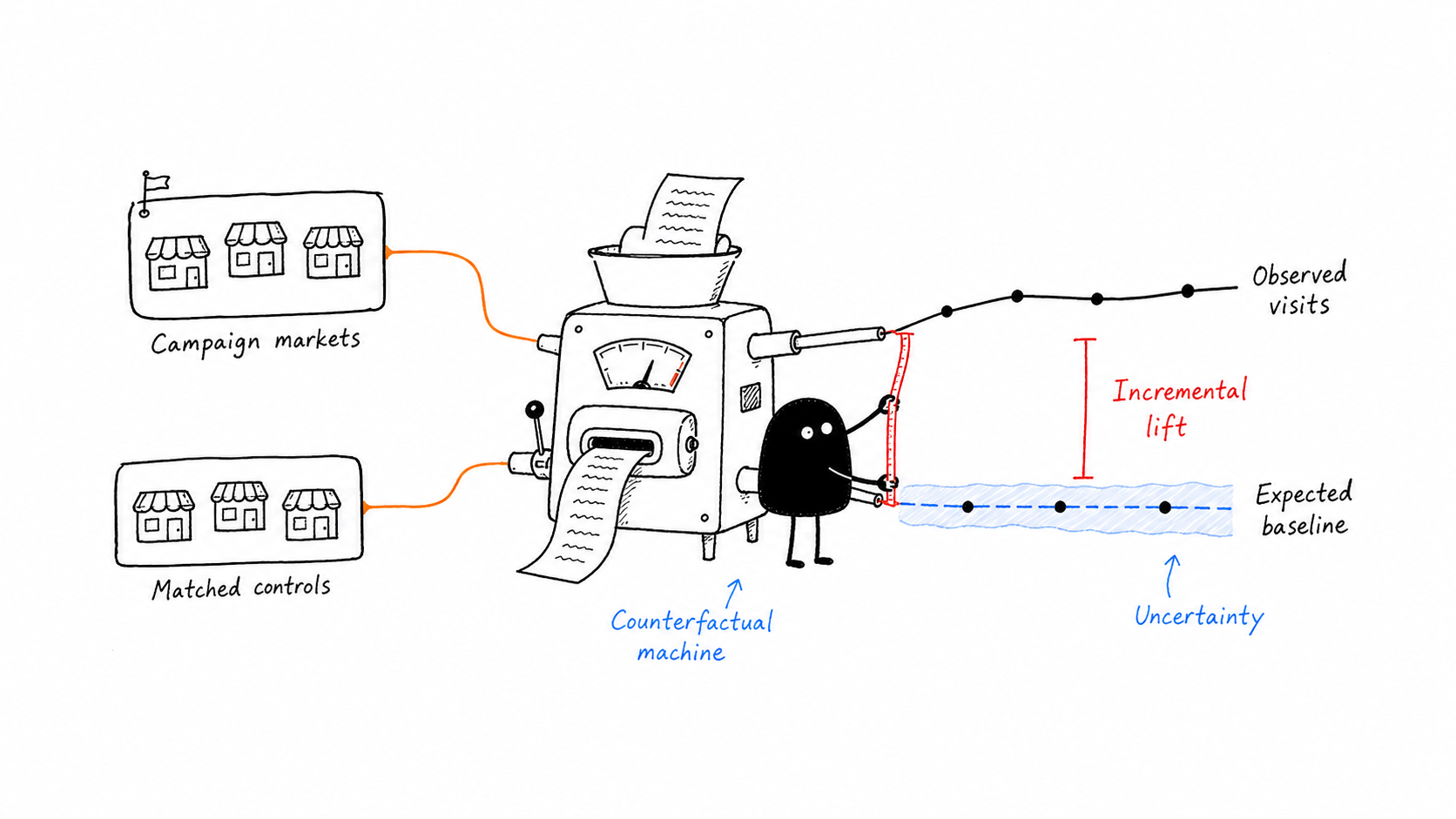
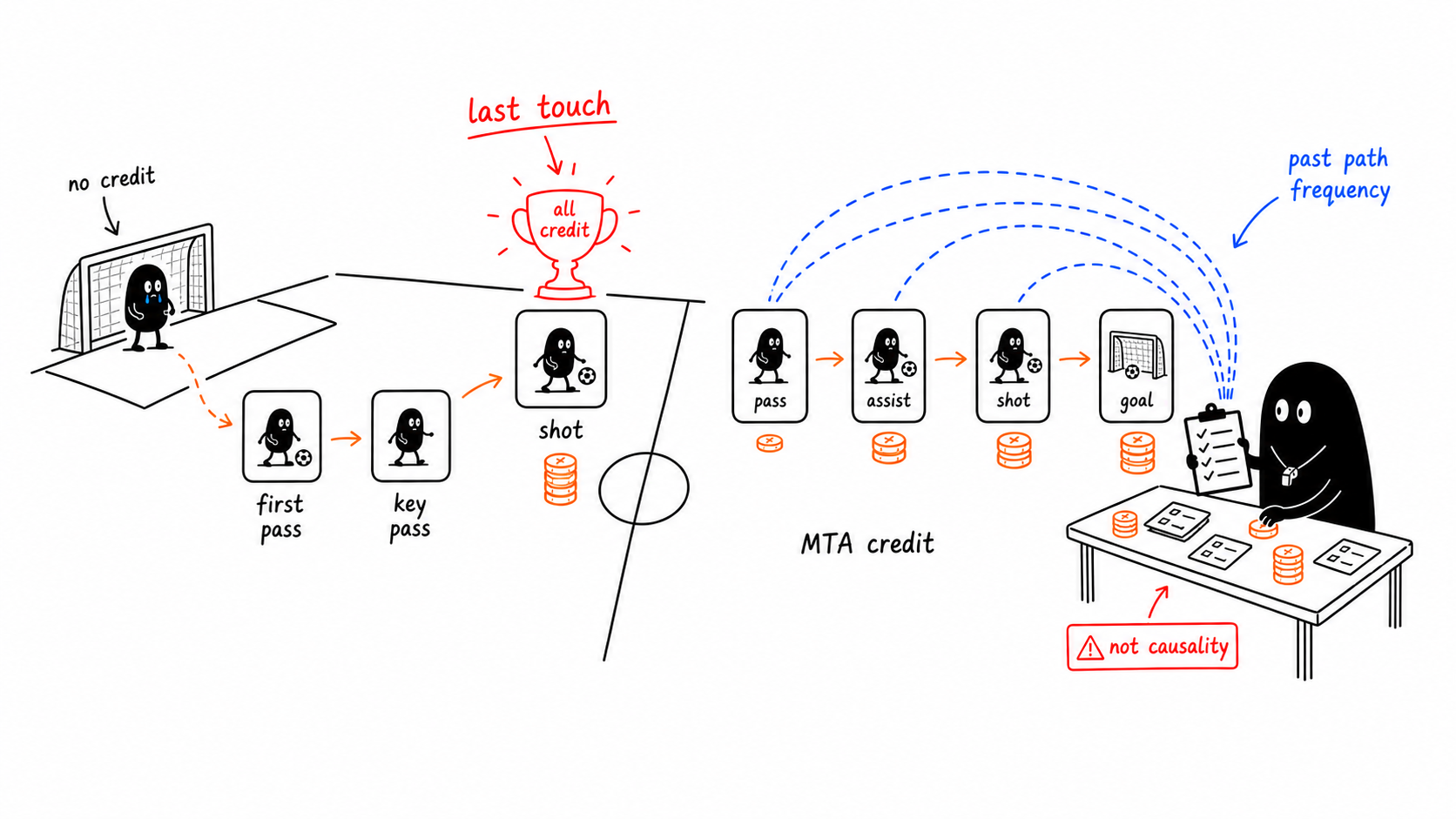
For example, I used this style to explain Matched Market Test (MMT) and Multi-Touch Attribution (MTA). Instead of opening with a wall of methodology text, the visual gives the room a concrete object to react to: a counterfactual machine for MMT, and a passing sequence for MTA.
Once the visual is clear, the analytical caveats become easier to discuss. For MMT, the caveat is control-market quality and counterfactual uncertainty. For MTA, the caveat is that attribution is journey contribution, not incrementality.
The workflow I like
- 01 / Find the hard ideaPick the one concept that usually slows the room down: counterfactual, baseline, control group, channel credit, lift, uncertainty, or causality.
- 02 / Make it physicalTurn the concept into something people can see: a machine, a bridge, a game, a queue, a map, or a weird but useful little scene.
- 03 / Keep the labels lightUse only enough labels to orient the viewer. If the image becomes a slide full of text, it loses the magic.
- 04 / Bring back rigorAfter the visual lands, explain the method, assumptions, diagnostics, and limitations with much less friction.
A simple visual can do what a thousand words often cannot: make a complex idea feel approachable. It does not replace the analysis. It opens the door so the analysis can be understood.
Try it yourself
In Codex, install the illustration skill from GitHub, then ask it to illustrate your own case study.
Install this as a Codex skill:
https://github.com/helloianneo/ian-xiaohei-illustrations

Then ask:
Use $ian-xiaohei-illustrations to illustrate my case study.
Like an artist, you can build a presentation style that matches your own taste, then scale it with AI. That is the fun part: your methodology can become recognizable, readable, and still technically serious.